
Rulers
Sewing and pattern-making rulers for designers, seamstresses, fashion students and studios: metal L-square rulers, clear cutting rulers for rotary cutters, a triangular pattern-making ruler, 61 cm curve rulers, a French curve, a clear pattern ruler with a handle, a 30 cm straight metal ruler and a T-shirt print placement ruler. The tools that turn measurements into an accurate pattern. Retail and wholesale sales, with nationwide shipping.
Products: 23




Sewing Rulers: From Measurements to Pattern
After measuring comes drafting. Every pattern is built from straight lines, right angles and curved lines: the neckline, armhole, hip line and hem. Each type of line has a ruler that suits it. A straight ruler cannot draw a natural curve, and a curve drawn freehand is hard to reproduce in the same shape on the other side of the pattern or in another size. The rulers are part of the Sewing Supplies category, alongside pins and needles.
Rulers by Subcategory
L-square rulers: three metal L rulers, 15×30, 25×50 and 61×40.5 cm, for drafting perpendicular lines and squaring fabric.
Cutting and quilting rulers: four clear rulers, 15×30 (in two marking styles), 15×25 and 10×45 cm, for cutting with a rotary cutter and marking seam allowances.
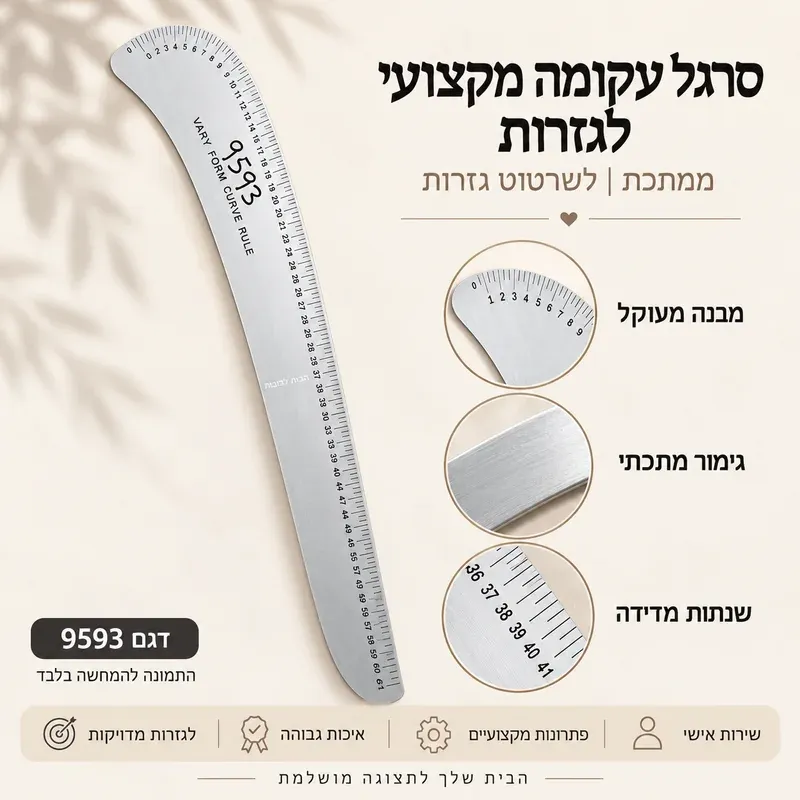
Curve rulers: a triangular pattern-making ruler, two 61 cm curve rulers in metal and plastic, a comma-shaped French curve and a clear pattern ruler with a handle.
The main category also includes a 30 cm straight metal ruler and a T-shirt print placement ruler.
Types of Rulers in This Category
L-square ruler: an L-shaped metal ruler with two arms meeting at a 90-degree angle. The 15×30 and 25×50 cm models are marked in millimeters with red numbers every 100 mm. The large one, 61×40.5 cm, with a 5 cm arm width and 2 mm thickness, is marked in centimeters and millimeters. Used for the base of a pattern, for lines perpendicular to the center line and for squaring the edge of the fabric before cutting.
Clear cutting ruler: a full grid and 30, 45 and 60-degree angle lines on all four models. The two 15×30 cm models are made of acrylic: one with yellow and black markings and a hanging hole, the other with black markings and 2.8 mm thick. The 15×25 cm model, made of rigid plastic, fits easily in a sewing bag, and the narrow 10×45 cm ruler is suited to cutting long strips.
Triangular pattern-making ruler: a plastic ruler with a straight edge marked up to 49 cm, curves for the front and back neckline and armhole, a curve for children's patterns and a curved edge for the side seam and hip line. It combines the functions of a straight ruler and several curve rulers in one tool.
61 cm curve ruler (hip curve): the curve changes gradually, sharp at one end and opening almost into a straight line at the other. Used for the hip line, the side seam of skirts and trousers, rounded hems and sleeves. There is a metal version, with graduations from 0 to 61 cm along the arc, and a yellow plastic version with the same markings and a hanging hole.
French curve: a clear comma-shaped ruler, 29.9×12.6 cm, with pink centimeter markings along both edges. At the rounded end there is a tight curve and five round holes of different sizes. Its short curves are suited to armholes, necklines, sleeve caps and collars.
Clear pattern ruler with a handle: 43×19 cm, with a straight edge, a curved edge and a curved window in the center that serves as a grip handle and as a template for a small curve. It has a grid of parallel lines, angle lines and seam allowance markings in pink, which makes it convenient for copying and correcting existing patterns.
30 cm straight metal ruler: a metal ruler with centimeter and millimeter markings, set in an orange rigid plastic protective frame, with a hanging hole. Metal does not warp from heat and keeps a straight line, so this is a basic ruler for short measurements and for drafting on pattern paper and fabric.
Print placement ruler: a clear plastic ruler whose top edge is cut in the shape of a collar, with necklines for adults, youth, toddlers and infants, a center line and a V-neck marking. The markings are in inches. It is not used for pattern making, but for placing a print, heat transfer vinyl or embroidery on a finished T-shirt.
How to Choose a Sewing Ruler
By type of line: perpendicular lines with an L-square ruler, long curves with a 61 cm curve ruler, short, deep curves with a French curve or the triangular ruler, and parallel lines with a grid ruler.
Transparency: a clear ruler lets you see the pattern lines and the fabric underneath, which makes precise alignment and copying easier.
Marking color: yellow and black markings stand out on both light and dark fabric. Pink markings stand out on white pattern paper.
Metal or plastic: metal does not warp and its edge does not wear down. Plastic and acrylic are transparent and let you see through them.
Length: 25 to 30 cm for details and seam allowances, 45 cm and up for long lines and cutting strips.
Basic Ruler Kit for Pattern Making
L-square ruler, 25×50 or 61×40.5 cm
Triangular pattern-making ruler
61 cm curve ruler
French curve for armholes and necklines
Clear grid ruler for seam allowances
Non-stretch tape measure
Professional Tips
Seam allowance: place the clear ruler so the seam line sits on the 1 cm line, or 1.5 cm depending on the pattern, and mark along the edge of the ruler.
Grain line: measure from the line marked on the pattern to the edge of the fabric at two points. If the distance is the same, the pattern is laid straight.
Smooth curve: mark at least three points on the curve and find the part of the ruler that passes through all of them. Draft a long curve in stages, each stage overlapping the previous one, so no angle forms in the line.
Check on the dress form: after drafting and the first sewing, put the garment on a dress form and check the lines. To choose a dress form in the right size, see our guide to choosing a dress form.
Caring for Your Rulers
Do not iron over a plastic ruler or leave it near a heat source, so it does not warp.
Store flat or hanging. Some of the rulers have a hanging hole.
Clean with a soft cloth and water, without solvents, so as not to erase the markings.
Related guide: Pattern-Making Rulers: L-Square, Curve and Cutting – What Each Ruler Draws
Wholesale Rulers for Schools and Studios
HaBayit LaBubot also sells sewing and pattern-making rulers wholesale to fashion schools, sewing programs, workshops, studios and shops, with the price quote based on quantity. For details, contact us by phone at 03-9444226 or on WhatsApp at 055-2473993. You can pick up from 15 Kfar Giladi St. or 17 HaMashbir St. in Tel Aviv, or order delivery nationwide.
Frequently asked questions
Which rulers do you need for pattern drafting?
A basic set includes an L-square for perpendicular lines, a triangle ruler for pattern drafting, a long curve ruler for hip lines and hems, a French curve for armholes and necklines, and a clear grid ruler for seam allowances. To measure the body before drafting, you also need a tape measure that doesn't stretch.
What is the difference between a hip curve and a French curve?
A hip curve, such as the 61 cm curve ruler, is a long ruler with a gradually opening curve, for long lines such as the hip line, a skirt side seam and a rounded hem. A French curve is short, with sharper curves, for short, deep lines such as the armhole, neckline and sleeve cap. Pattern making uses both.
Which ruler is suitable for cutting with a rotary cutter?
A clear, rigid cutting ruler with a grid and angle lines, such as the 15×30, 15×25 and 10×45 cm rulers. The 15×30 cm ruler suits general cutting, and the 10×45 cm ruler suits long strips. Cut on a cutting mat, away from your body, with your palm pressing on the ruler and your fingers well away from the edge.
How do you add seam allowance to a pattern with a ruler?
Place a clear ruler so that the pattern's seam line sits exactly on the 1 cm line, or 1.5 cm depending on the pattern, and draw along the ruler's edge. On curved lines, move the ruler in small steps, mark points at the seam allowance width and connect them with a curve ruler. Add the seam allowance only after the seam line itself has been corrected.
How do you measure a curved line on a pattern, such as an armhole?
Use a ruler marked along its curve, such as the French curve or the 61 cm curve ruler, and move it along the line in sections. You can also stand a tape measure on its narrow edge along the line. This way you compare the armhole length with the sleeve cap length so the sleeve sets in without puckers.
What is an L-square ruler used for?
An L-shaped ruler is used to draw and check right angles: horizontal lines for the bust, waist and hip that are perpendicular to the pattern's centre line. In sewing it is also used to square the cut end of fabric to the selvedge before cutting, and to check the corners of pockets and rectangular pieces.
What is the difference between a clear ruler and a metal ruler?
Through a clear ruler you can see the lines and fabric underneath, which is handy for seam allowances, tracing and cutting with a grid. A metal ruler doesn't warp from heat and its edge doesn't wear from pencil or chalk, so it keeps a straight line for a long time.
What is a T-shirt print placement ruler used for?
Place the collar-shaped cut-out edge against the collar seam, align the neckline that matches the shirt size, and read off the grid the distance from the collar and from the center line. This way you place a print, heat transfer vinyl or embroidery in the same spot on every shirt. The ruler is marked in inches.
Should I choose a ruler in centimeters or inches?
In Israel people usually work in centimeters, and most rulers in this category are marked in centimeters and millimeters. The print placement ruler is marked in inches. If you work with American patterns, pay attention to the units on the pattern.
How do you look after a clear ruler?
Store it flat or hanging, away from heat sources, and clean it with a soft cloth and water, without solvents. Don't iron on it, because heat can warp it and damage the markings.