הבית לבובות דיגום ותצוגה
Women's Dress Form with Hips on an Adjustable Pole and Wheels – Cream Fabric, Sizes 80–92
In stock
SKU: 10860
Product description
Women's dress form with hips: full body to mid-thigh, for working at eye level
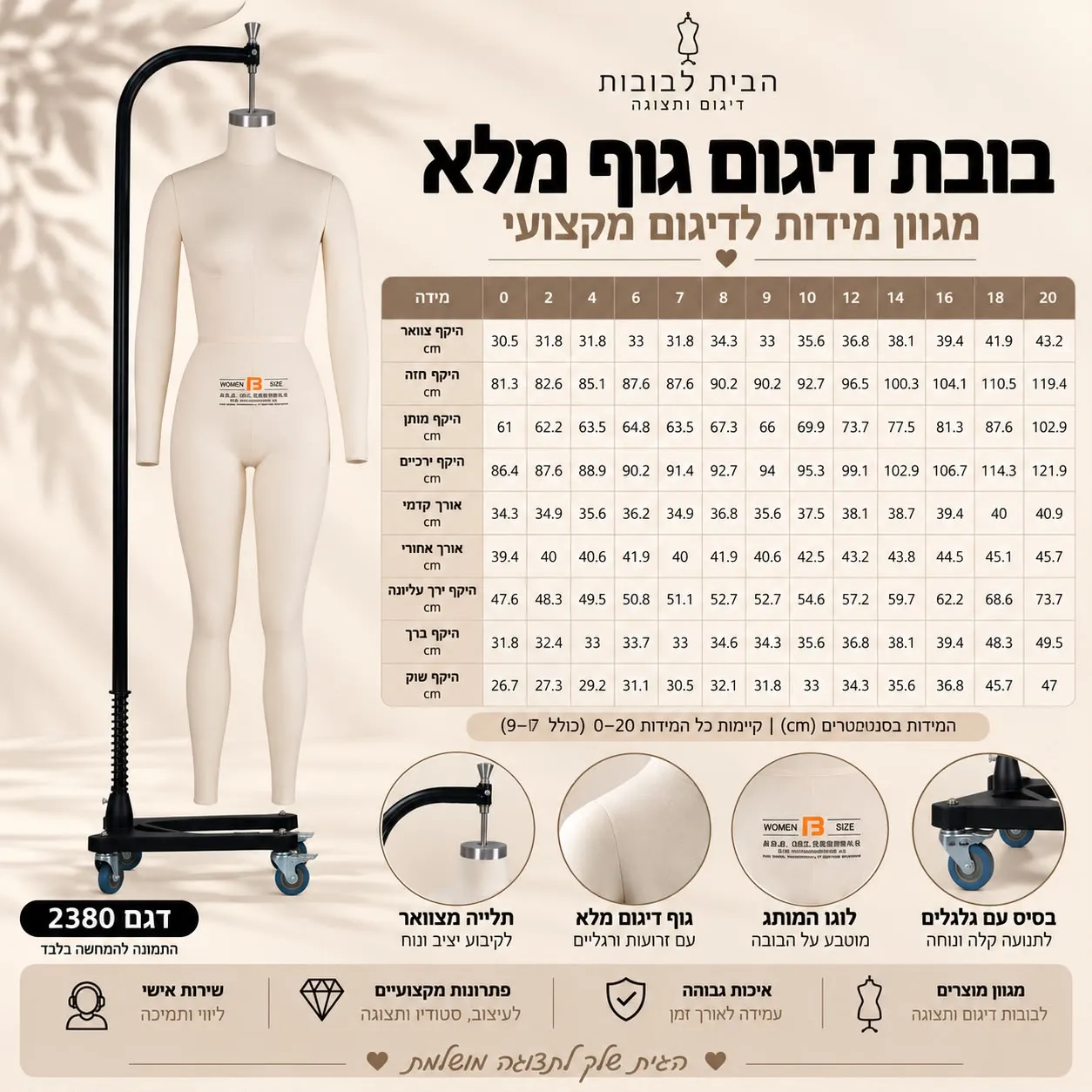
A regular dress form ends at the hipline. In this form the body continues to mid-thigh, which lets you see how the garment falls below the pelvis, and not only how it sits at the waist. This is a women's dress form in a fixed size, with natural body lines: rounded shoulders, a shaped bust, a defined waist and full hips.
A rigid Styrofoam core (polystyrene) covered in cream fabric lets you push pins straight into the body of the form, secure fabrics, mark lines and build a garment on the form as on a real client. At the top there is a metal grip head for lifting and hanging fabrics, and at the neck there is a cap that hides the pole.
The form sits on a black metal pole with a tightening knob, which adjusts the total height between 120 and 170 cm. A seamstress who works seated lowers the form, and someone checking hem length raises it to eye level. The base with five casters lets you roll the form between the cutting table, the sewing machine and the fitting corner without lifting it.
Six fixed sizes, each with exact measurements
The form comes in sizes 80, 82, 84, 86, 88 and 92, by bust circumference in cm. Each size is defined by four measurements: shoulders, bust, waist and hips. In size 80, for example, the circumferences are bust 80, waist 60 and hips 86 cm. In size 92: bust 92, waist 72 and hips 98 cm. The full table appears in the technical specifications.
How this model differs from other forms in the category
Versus an adjustable dress form with adjustment dials: An adjustable form has gaps between the body parts, and you can't push pins in deeply. Here the body is continuous, and the whole surface is suitable for pinning.
Versus a dress form on a wooden stand: A wooden stand suits a fixed station. This pole with casters suits a studio where you move the form all day.
Versus a fiberglass display mannequin: A display mannequin is meant to show a finished garment and you can't push pins into it. A dress form is a working tool for building the garment.
Common uses
Draping: building a pattern directly on the form, without a prior drawing
Fitting fitted dresses, pencil skirts and evening and bridal gowns, down to below the hipline
Work on bodysuits, swimwear, underwear and fitted sportswear, where the hipline and crotch matter
Marking balance lines, the waistline and the hip line before cutting
Setting hem length and marking the hem at a comfortable working height
Showing a sample in the studio or at a design school's graduation show
Who the form is for
Independent seamstresses who build clothes to order and want a form in a size close to their regular client
Fashion designers and studios who develop a collection in one base size and test each style on the same body
Design and sewing schools that need several identical forms for a class, in different sizes for each group
Clothing repairers who adjust lengths and take in garments below the hipline
For quantity orders for a studio, a school or a store, and for wholesale prices, contact us by phone at 03-9444226 or on WhatsApp at 055-2473993. You can also see the form in our showroom in Tel Aviv.
Professional tips for working with the form
Push pins in diagonally, not perpendicular. A pin that goes in at an angle grips the Styrofoam well and leaves fewer marks in the fabric.
Mark lines with tape and not with a marker. A narrow tape pinned along the waist, bust and side lines gives reference lines that can be moved, and a marker leaves a stain in the fabric forever.
Fit the form to the client with padding. It is easy to enlarge a form with thin padding at a specific point, such as the bust, hip or back. You can't make it smaller.
Tighten the knob before working. A loose pole slowly sinks while you pin and throws off the length measurement.
Iron the garment before dressing the form. A hot iron directly on the form may damage the cover fabric and the Styrofoam beneath it.
Common mistakes in choosing and using
Choosing by garment size and not by measurements. Garment sizes vary between brands. Measure the client's bust, waist and hips and compare to the table.
Choosing a size bigger than the client "to be safe". A large form can't be made smaller. Choose an equal size or slightly smaller, and fill in with padding.
Looking only at the bust circumference. Next to each size the waist and hips are also listed. For a client with hips wide relative to the bust, choose by the hips and pad the bust.
Buying a display mannequin for sewing work. A fiberglass or plastic mannequin looks similar, but you can't push pins into it.
Images are for illustration only; slight color differences may occur between different screens.
Specifications
Model number: 10860
Type: Women's pinnable dress form, body to mid-thigh
Size type: Fixed size (not adjustable)
Available sizes: 80, 82, 84, 86, 88, 92
Size 80: Shoulders 37 | Bust 80 | Waist 60 | Hips 86 cm
Size 82: Shoulders 37.5 | Bust 82 | Waist 62 | Hips 88 cm
Size 84: Shoulders 38 | Bust 84 | Waist 64 | Hips 90 cm
Size 86: Shoulders 38.5 | Bust 86 | Waist 66 | Hips 92 cm
Size 88: Shoulders 39 | Bust 88 | Waist 68 | Hips 94 cm
Size 92: Shoulders 41 | Bust 92 | Waist 72 | Hips 98 cm
Total adjustable height: 120-170 cm
Core: Rigid Styrofoam (polystyrene)
Cover: Cream-colored fabric
Pinnable: Yes, straight into the body
Pole: Black metal with a tightening knob for height adjustment
Base: 5 arms with casters
Color: Cream, black pole and base
Sold as: Per unit
Frequently asked questions
Frequently asked questions
What sizes does the dress form come in, and what are the measurements of each size?
There are six sizes: 80, 82, 84, 86, 88 and 92, according to the bust circumference in cm. In the smallest size, 80, the measurements are bust 80, waist 60 and hips 86 cm, with shoulders of 37 cm. In the largest size, 92, the measurements are bust 92, waist 72 and hips 98 cm, with shoulders of 41 cm. Between sizes, the waist and hips grow by 2 cm at each step.
What is the form made of and can I stick pins into it?
Yes. The core of the form is made of rigid foam (polystyrene) covered with cream-colored fabric, so you can stick pins straight into the body over the whole area, from the shoulders to the hips. It is worth inserting diagonally and not perpendicular: that way the pin grips better and leaves fewer marks in the fabric.
What height does the form's post adjust to?
The total height adjusts between 120 and 170 cm, using a tightening handle on the metal post. The low height is comfortable for working seated, and the high height suits checking hem length and how a garment falls at eye level. The base with five casters lets you move the form around the studio without lifting it.
How do you choose the right size of dress form?
Measure the client's bust, waist and hip circumference, or the basic size of the collection, and compare to the chart. Choose an equal or slightly smaller size, because it's easy to enlarge a form with padding and you can't make it smaller. When the bust and the hips fall in different sizes, choose according to the smaller size and pad the other area.
What is the difference between a dress form with hips and a regular dress form?
In a regular dress form the body ends at the hip line. In this form it continues to mid-thigh. This lets you check how the garment sits below the pelvis: fitted dresses, pencil skirts, bodysuits and swimwear. For garments that end at the waist or above it, the difference is small.
What do the numbers 80 to 92 mean on the form?
The number is the bust circumference in centimeters. Size 80 is a form with an 80 cm bust, and size 92 with a 92 cm bust. Each size also has fixed shoulder, waist and hip circumferences.
Can I sew pants on the form?
The form continues to mid-thigh, so it suits checking the waistline, the hips and the upper part of the pants. For sewing full pants with legs, you need a form with legs.
How do you pad the form to a client's measurements?
Attach thin layers of batting or fleece in the areas where the client is wider than the form, and cover with a snug fabric cover. This fits the form to a specific body without changing the base.
Why does the form have casters?
To move it around the studio and rotate it easily while working, without lifting it. This is especially convenient when checking a garment from all sides.
Is the form suitable for a sewing school?
Yes. A fixed-size form with a body for pinning suits pattern-making and sewing studies. You can order several forms in the same size or in different sizes for a class.