הבית לבובות דיגום ותצוגה
Pinnable Women's Dress Form on an Adjustable Rolling Stand – 13 Fixed Sizes
In stock
SKU: 10583
Product description
A fixed-size dress form – a reliable base for every pattern
A fixed-size dress form is built to predefined body measurements, and has no spacing mechanism or adjustment dials. The circumferences don't move, the body lines are continuous, and what you measure on the form today will measure exactly the same a year from now. That is why seamstresses, designers and fashion schools work mainly with fixed-size forms. When you build a pattern, fit a garment or drape fabric directly on the body, you need to know exactly which size you are working on.
The body is covered in cream-colored fabric and is meant for pinning. You can secure layers of fabric on it, mark the waistline and bustline and build puffs without the fabric sliding. At the top of the form there is a metal finishing knob. The adjustable stand lets you work seated or standing, and the metal base with casters moves the form between work stations without lifting it.
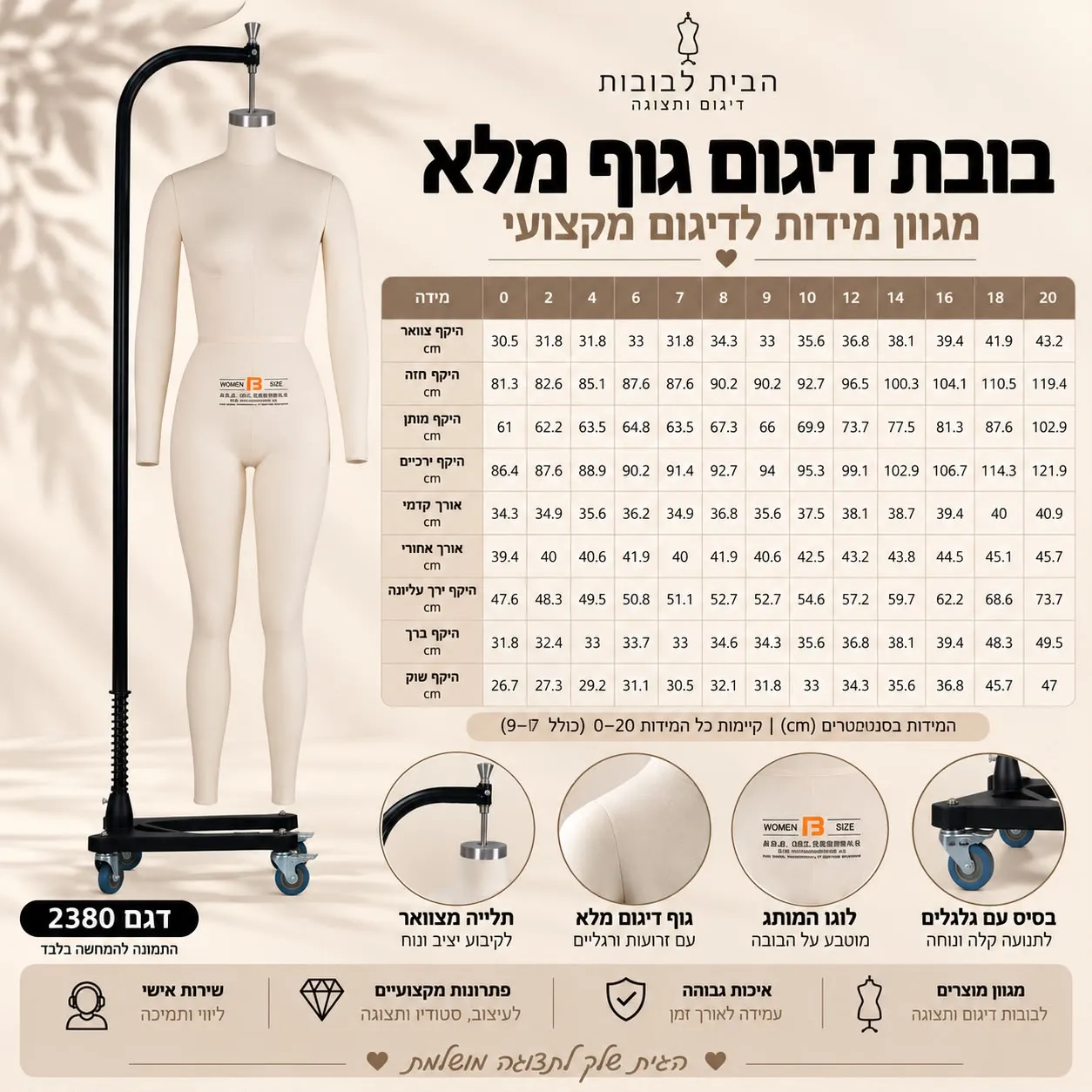
13 sizes with a full size chart
The form comes in 13 sizes under the American sizing system: 0, 2, 4, 6, 7, 8, 9, 10, 12, 14, 16, 18 and 20. Sizes 7 and 9 are in-between sizes that suit a younger, slimmer cut. For each size the neck, bust, waist and hip circumferences, shoulder length, front length, back length, distance between bust points and back width are listed. For example, in size 0 the bust is 81.28 cm, the waist 60.96 cm and the hips 86.36 cm. In size 20 the bust is 119.38 cm, the waist 102.87 cm and the hips 121.92 cm. The numbers aren't round because the sizes are originally defined in inches: 32 inches is 81.28 cm.
How it differs from other forms
Versus an adjustable dress form: In an adjustable form you widen the body with dials, and gaps open between the parts. Here the body is continuous, and it is easier to mark lines on it and drape fabric over it.
Versus a display mannequin or display form: Display forms are usually made of fiberglass or rigid plastic, and you can't push pins into them. This form was built for work, not for a shop window.
Versus forms whose size is set by bust circumference in cm: Here you choose a size by the 0 to 20 system, and each size has a full set of nine body measurements. Even someone who works with American patterns can match the form to the pattern directly.
Common uses
Building a pattern and draping fabric directly on the body (draping)
Fitting and measuring evening dresses, wedding dresses, suits and shirts
Marking bust, waist and hip lines before cutting
Checking fabric drape and correcting a pattern before final sewing
Teaching and demonstration in sewing classes and fashion design schools
Photographing clothes for a catalog and social media once the garment is ready
Who the form is for
Fashion designers working on a collection in a fixed base size
Professional seamstresses and tailors who make adjustments and repairs for clients
Bridal and evening gown studios working with layers of heavy fabric and lace
Design schools and fashion programs that need several identical forms in the same size for the whole class
Sewing beginners who want to work with a professional tool from the start
For quantity purchases, for schools, studios and stores, we sell wholesale as a direct importer. You can put together an order of one size or of several different sizes. For details and a price quote, contact us by phone or WhatsApp.
Professional tips
Choose the size by the body and not by the label in clothes. Measure the bust, waist and hip circumferences and compare to the size chart. Ready-to-wear sizes vary from brand to brand.
When you hesitate between two sizes, choose the smaller. You can add volume to a dress form with padding, but you can't reduce it.
Push pins in at a sharp angle and not perpendicular. That way the pin holds better and the fabric doesn't tear at the pinning point.
Adjust the height so the waistline is at eye level when working on a skirt or a waistline, and raise the form when working on the collar and shoulders.
Lock the casters or place the form against a wall when working on a heavy dress, so the form doesn't move while you mark.
Common mistakes
Confusing shoulder length with shoulder width. In the size chart, shoulder means the length of the shoulder seam, from the base of the neck to the tip of the shoulder. It is not the shoulder width from side to side.
Buying a display mannequin instead of a dress form. They look similar in a photo, but you can't push pins into a display mannequin.
Translating 0 to 20 directly into Israeli sizes. There is no single conversion that fits all brands. The accurate way is to compare circumferences in centimeters.
Working on a form that is too small and stretching fabric over it. Fabric stretched over a small form gives a pattern narrower than needed, and the mistake is discovered only after sewing.
Images are for illustration only. Slight color differences may occur between different screens.
Specifications
Product type: Women's fixed-size dress form
Model: 10583
Use: Fitting, adjustment and pinning
Body: Anatomical, fabric-covered, suitable for pinning
Body color: Cream
Top finish: Metal knob
Stand: Metal stand with adjustable height
Height adjustment range: 80–132 cm
Base: Metal, with 4 casters
Floor footprint: 35×35 cm
Weight: 4.7 kg
Sizing system: American 0–20
Available sizes: 0, 2, 4, 6, 7, 8, 9, 10, 12, 14, 16, 18, 20
Measurements per size: Neck, bust, waist and hip circumference, shoulder length, front length, back length, distance between bust points, back width (in cm, per the size chart)
Bust circumference range: 81.28–119.38 cm
Waist circumference range: 60.96–102.87 cm
Hip circumference range: 86.36–121.92 cm
Shoulder length range: 11.27–15.88 cm
Front length range: 34.29–40.64 cm
Back length range: 39.37–45.72 cm
Distance between bust points: 16.19–24.13 cm
Back width range: 33.02–40.64 cm
Sold as: Per unit
Frequently asked questions
Frequently asked questions
How do you choose a size for a dress form in sizes 0 to 20?
Choose by bust, waist and hip circumference in centimeters, not by garment size. Measure the body or take the pattern's measurements, and look in the chart for the closest size. When the measurement falls between two sizes, choose the smaller one and add padding where needed. You can add volume to a dress form, but you can't make it smaller.
What are the measurements of the form in the smallest and largest sizes?
In size 0: bust 81.28 cm, waist 60.96 cm, hips 86.36 cm. In size 20: bust 119.38 cm, waist 102.87 cm, hips 121.92 cm. Between them there are 11 more sizes, and each has a full chart with neck, shoulder length, front length, back length, distance between bust points and back width.
Can pins be stuck into this form?
Yes. The body is fabric-covered and intended for pinning, and you can fix fabric on it, mark seam lines and build darts. Stick the pins at a sharp angle and not perpendicular, so they hold well. Display mannequins made of fiberglass or rigid plastic aren't suitable for this.
What height can the form be adjusted to?
The height adjustment range is 80 to 132 cm. The height is adjusted with a mechanism with a locking screw on the stand post. That way you can work seated at the hem of a skirt or standing at the shoulders and collar. The base is metal, with 4 casters, takes up a floor area of 35×35 cm, and the whole form weighs 4.7 kg.
What is the difference between a fixed-size dress form and an adjustable one?
In a fixed-size form, the circumferences are fixed and the body is continuous, with no gaps between parts. This allows precise marking and clean dressing of fabric. In an adjustable form, you expand the body with dials, which is convenient for someone sewing for several sizes. With a fixed-size form the pattern comes out more accurate, so it is the common choice in studios and design schools.
What is the meaning of sizes 0 to 20 in a dress form?
This is the American sizing system for women's clothing, and not an Israeli garment size. Each size has a table of circumferences in centimeters, so you choose by the circumferences and not by the number.
How do you pad a dress form to a client's measurements?
Add thin layers of batting or fleece in the areas where the client is wider than the form, and put a snug fabric cover over them. This way the form fits a specific body without changing its base.
Why is it important for a dress form to have casters?
The casters let you move the form around the studio and rotate it without lifting it. This is especially convenient when working on a skirt hem or checking a garment from all sides.
Is the form suitable for a fashion design school?
Yes. A fixed-size form with a fabric-covered body is the common working tool in pattern-making and draping studies. You can order several forms in the same size or in different sizes for a class.
How do I take care of a fabric-covered dress form?
Cover it when you are not working on it, so it does not collect dust. Clean light stains with a damp cloth and mild soap, without soaking the body, and remove the pins at the end of each workday.