Kids' Hangers: How to Choose Hanger Width by Age and Clothing Size

How to choose kids' hangers by age and shoulder width: width ranges from manufacturer guides, measuring the garment, bar and notches, color-coded size marking in the store and organizing a kids' closet at home.
Children's hangers are chosen by the shoulder width of the garment; age is only a starting point. As a general guideline, hanger manufacturers' size guides place baby clothes at around 25-26 cm, preschool and early school clothes at around 30 cm, older children at around 36 cm, and from the teenage years on you move to widths of 41 cm and up. There is no single standard and the ranges overlap, so the final test is always the garment itself: the tip of the hanger should end slightly before the shoulder seam.
Why an adult hanger damages children's clothes
A regular adult hanger is usually about 38 to 46 cm wide, according to manufacturers' guides. On a five-year-old's shirt its ends stick out past the shoulder seam, and that is where three problems begin that repeat in every wardrobe and every store.
Shoulder bumps: a hanger tip that sticks out past the seam creates "horns" in the fabric and stretches the shoulder seams. In knits and jersey the bump stays even after the garment is taken off the hanger.
Stretched necklines: to get a wide hanger into a baby top, you push it through a narrow neck opening. The rib or elastic at the neck stretches, and after a few times the opening no longer returns to its shape.
Slipping and falling: a small garment on a wide hanger rests only on the hanger's tips, tilts to one side and slides to the floor. In a store it looks neglected, and at home it ends up in a pile at the bottom of the wardrobe.
Even with the right size hanger, it is better to insert it into a shirt with a narrow neckline from below, through the hem, rather than through the neck.
Children's hangers by age: what manufacturers' guides say
Hanger manufacturers supplying fashion chains publish guides that pair each hanger width with an age range. Comparing several of them shows a similar direction, but the boundaries shift from guide to guide. The figures here are presented as a general guideline only, not as a standard.
Babies, up to age two: a guide by a British hanger manufacturer for a fashion chain specifies a 26 cm hanger for ages 0-24 months. Another guide from the same manufacturer splits it: 22 cm up to three months, and 26 cm for ages 3-12 months. American suppliers list a 10-inch baby hanger, about 25 cm.
Toddlers and preschool: most sources place a 30 cm hanger here, or 12 inches with American suppliers. One guide specifies it for ages 2-7, another for ages 1-4.
Primary school: the British guides list a 36 cm hanger, once for ages 5-10 and once for ages 8-13. One American supplier lists 14 inches, about 36 cm, for young teen clothing, while another keeps the 12-inch hanger until the start of adolescence.
Teens: from age 11 to 14, depending on the guide, you move to a 41 cm hanger, and from there to adult-size hangers.
The practical conclusion: the age on the label helps narrow down the options, but a child who is tall for their age or a garment with a loose cut will change the answer. That is why it pays to check the garment itself.
How to match hanger width to a garment in practice
Lay the garment flat on a table and straighten the shoulders.
Measure in a straight line from one shoulder seam to the other.
Choose a hanger about 2.5 to 5 cm narrower than that measurement, so that each end of the hanger stops a centimeter or two before the seam.
Hang it and check: if the ends stick out past the seam, the hanger is too wide. If the shoulders droop down on both sides of the hanger and the garment slips, it is too narrow.
In a store there is no need to measure every item. It is enough to measure one garment from each size range in the collection, decide which width suits it, and assign that width to the whole size range.
The widths and designs in our category
The children's hangers category has two types of hangers, and each one solves a different need.
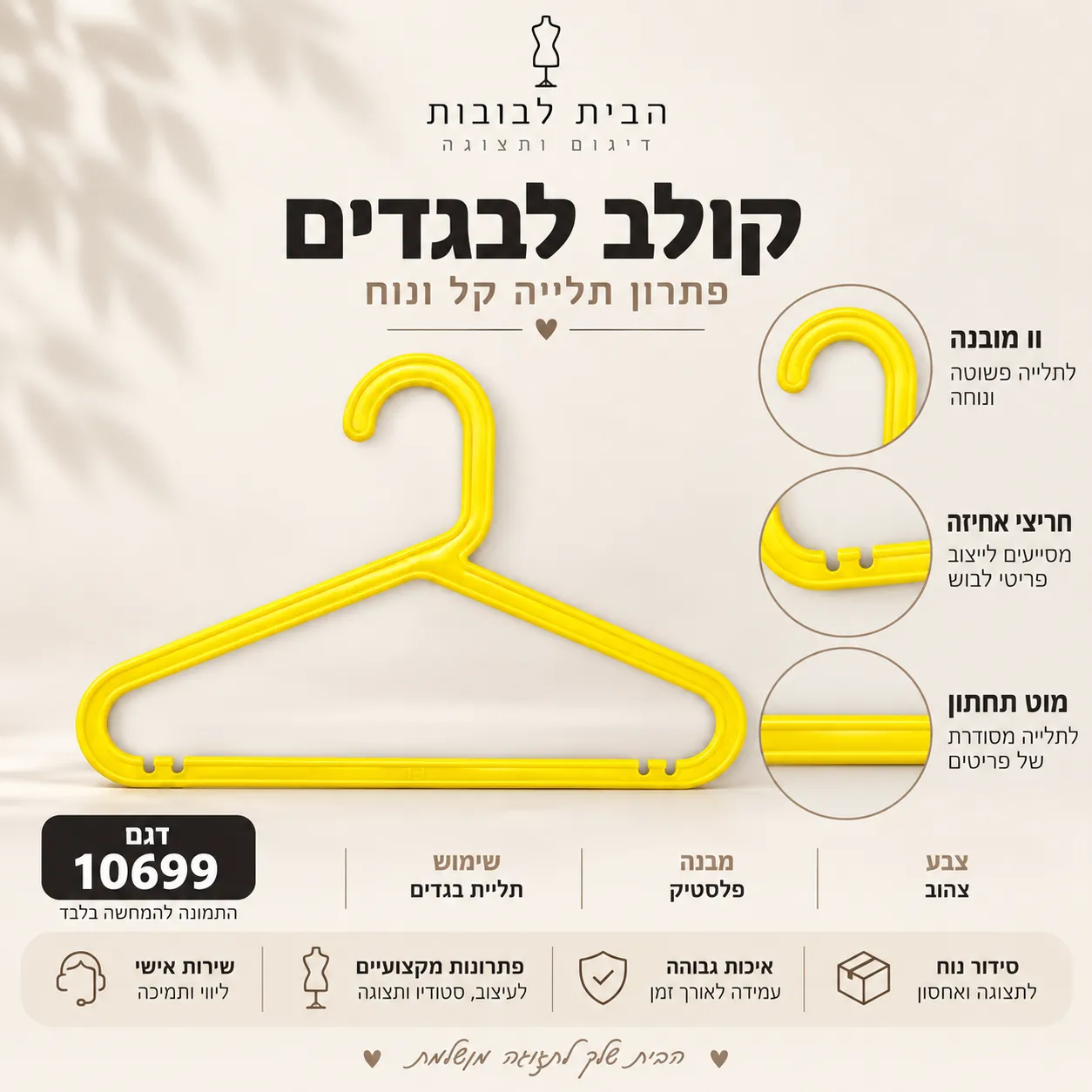
Children's hanger 33×20.5 cm: one-piece molded plastic, with a hook molded as part of the hanger body, rounded shoulders, a bottom bar and grip notches at the ends of the bar. According to the product page, the width suits children's clothes from roughly preschool age to the end of primary school. The series comes in eight colors in identical sizes: white, black, pink, light pink, blue, light blue, yellow and turquoise.
White plastic hanger in 3 sizes: the white hanger with a swivel metal hook comes in a width of 26 cm for babies and toddlers, 33 cm for children and 43 cm for adults. It has a strap notch on each shoulder and no bottom bar, so it is intended for tops and dresses.
What each part of the hanger does for children's clothes
Bottom bar: lets you fold trousers, leggings or a skirt over it, or hang a complete set of top and trousers on one hanger. According to the product page, the bar is intended for light garments; a coat or heavy jeans are better hung by the shoulders or on a sturdier hanger.
Notches: hold the thin straps of summer dresses and tank tops, as well as the hanging loops of skirts.
Swivel hook: lets you turn the garment in the desired direction without taking the hanger off the rail, useful when you want all the garments on a rack to face the same way.
Hook molded into the hanger body: there is no joint that can come loose, which is convenient in a wardrobe that children use by themselves.
Color-coding sizes with hangers in a children's clothing store
In a children's clothing store, the hanger can also serve as a size marker. When each size range gets a fixed color, customers spot their section from afar, and staff return garments to their place without reading labels. The yellow hanger page gives an example of such a system: yellow for ages 4-6.
A few rules that appear in merchandising guides for children's stores:
Do not mix hanger widths within the same size range. A uniform rack looks tidy and makes it easier to compare items.
Keep a fixed color for each size range across all seasons, otherwise the code loses its meaning.
Use white or neutral hangers as the base, and save bold colors for a special collection or a promotion.
Add size dividers on the rail and size markers on the hangers, so the system does not rely on color alone.
Train staff on which hanger belongs to which size range, and replace broken hangers right away.
With the 33 cm series you separate size ranges by color, and with the white hanger in 3 sizes you separate them by width. You can also combine the two: white at 26 cm for babies, and a range of colors at 33 cm for preschool and primary school. Stores and chains can get a wholesale quote based on quantity, by phone at 03-9444226 or on WhatsApp at 055-2473993.
A child's wardrobe at home: a hanger that grows with the child
At home the principle is the same, just on a smaller scale. A few habits that save clothes from being stretched:
One size for each stage: when you move up a clothing size, check the hangers too. A new garment whose shoulders already droop on both sides of the hanger is a sign it is time for the next width.
Sets on one hanger: a top on the shoulders and trousers folded over the bar. That way holiday outfits or an outfit for an event stay together.
Coats separately: an older child's winter coat is heavier than a light children's hanger is designed to carry. For such garments and for teen clothes, move to stronger, wider hangers from the general hanger selection.
Outgrown clothes: if you are keeping them for a younger sibling, store them together with hangers in the right size, so they are ready to hang when the time comes.
For an overview of all hanger types by material, from wood and metal to crystal, see the guide Types of hangers for a clothing store. If you are looking for light, durable hangers for everyday use, there is also the plastic hangers category.
All widths and colors are gathered in the children's hangers category, and you are welcome to visit the showroom at Kfar Giladi 15 in Tel Aviv. If you are planning a hanger setup for a children's clothing store and want to organize it by widths and colors, contact us and we will help you match the quantities.
Frequently asked questions
Is a 33 cm hanger also suitable for toddler clothes?
Manufacturer guides usually place toddler clothes around a 30 cm hanger, so a 33 cm hanger is slightly wide. It will work for loose-fitting garments, but for narrow tops for ages one to three, check that the hanger ends don't stick out past the shoulder seam. If they do, a 26 cm hanger is a better fit.
How do you measure a garment to know what hanger width you need?
Lay the garment flat and measure in a straight line from one shoulder seam to the other. The right hanger is about 2.5 to 5 cm narrower than this measurement, so each end stops just short of the seam. If the ends stick out beyond the seam, the hanger is too wide.
Why do children's shirts stretch at the neck when you hang them?
It usually happens when a wide hanger is pushed through a narrow neck opening, stretching the neck rib or elastic. The solution is a hanger whose width suits the garment, inserted from below through the hem of the shirt rather than through the neck. That way the neck opening keeps its original shape.
Is there a uniform standard for children's hanger widths by age?
No. Every manufacturer and chain defines its own ranges, and the same 36 cm width appears in one guide for ages 5-10 and in another for ages 8-13. So treat age as a general guideline, and make the final decision based on the garment's shoulder width.
How do you hang a child's shirt and trousers set on one hanger?
Hang the shirt on the hanger's shoulders and fold the trousers over the bottom bar. The 33 cm children's hangers are built with such a bar. The method suits lightweight clothes and keeps a holiday or party outfit together in one place.
Is a plastic children's hanger suitable for a winter coat?
A light children's hanger is mainly intended for light garments. According to the product page, a coat or heavy jeans are better hung on the shoulders or on a sturdier hanger. For coats of older children and teenagers, it's worth moving to a wider, more stable hanger.
How do you mark sizes on a rail in a children's clothing store without relying only on hanger colour?
Use size dividers that hang on the rail between size ranges, and size markers that slip over the hanger hook. Combining these with a fixed colour for each size range lets customers spot their section from a distance and confirm the size up close.
Should you mix hanger widths on the same store rack?
It's best to avoid it within the same size range. A rack with uniform-width hangers looks tidy, the garments hang at the same height and they are easy to compare. Different widths suit separate racks for different size ranges.
What is the difference between the white children's hanger in 3 sizes and the coloured 33 cm series?
The white hanger comes in 26, 33 and 43 cm, with a swivel metal hook and a strap notch on each shoulder, without a bottom bar. The 33 cm series is made of one-piece moulded plastic, with a moulded hook, a bottom bar and notches, in eight colours. The white one suits sorting by width, and the coloured one sorting by colour.
How can you tell a hanger is too small for a garment?
When the garment's shoulders droop down on both sides of the hanger, the garment leans to one side or slips off the hanger. That's a sign the garment's shoulder width is much larger than the hanger. In that case, move up to the next width, and for teen clothing to an adult-size hanger.