Sewing Machine Needles: How to Choose by Fabric Type and Weight

How to choose a sewing machine needle for your fabric: a map of woven and knit fabrics with the right size and point type for each, matching the thread, and spotting the wrong needle from stitch problems.
A sewing machine needle is chosen by answering three questions, in this order: is the fabric woven or knit, how heavy is the fabric, and which thread are you sewing with. The answer to the first question determines the point type: universal for woven fabric, ball point for knits. The answer to the second determines the size, usually from 70/10 for fine fabrics to 100/16 for heavy ones. The third checks that the thread passes through the needle eye without friction. This guide goes fabric by fabric, maps each fabric to the needle that suits it, and explains how to tell from the stitching itself that the needle is wrong.
Three questions before choosing a sewing machine needle
Most home sewing machines use needles of the 130/705H system, also marked HAx1 or 15x1. These needles have a shank that is flat on one side, so they fit into the machine only one way. According to the needle guide from the German manufacturer Schmetz, the letter H indicates a needle with a scarf above the eye, which lets the bobbin hook catch the thread, and a slightly rounded point. Once the system is clear, three decisions remain.
Woven or knit: woven fabric is made of warp and weft threads and can be pierced. Knit fabric is made of loops, and a needle that is too sharp can cut them. Check the cut edge: in a knit fabric such as jersey you can see rows of small loops, and the fabric stretches easily across its width.
Thickness and weight: the first number on the needle is the blade diameter in hundredths of a millimetre. A size 80 needle is 0.8 mm thick. A fine fabric needs a thin blade that leaves a small hole; a heavy fabric needs a strong blade that won't bend.
The thread: Schmetz recommends that the eye be about 40 percent larger than the thread diameter. Thread that is too thick for a fine needle frays and breaks.
A general explanation of needle systems and the markings on the package is on the Needles for Home Sewing Machines category page. Here we focus on the practical match between fabric and needle.
Fabric map: which needle for which woven fabric
The ranges here are taken from the product pages on our site and from manufacturers' charts. They are a starting point, and it is always worth sewing a few stitches on a scrap of the same fabric before you begin.
Chiffon, organza, fine silk and microfiber: 60/8 or 70/10. In these fabrics every hole shows, and a thick needle leaves marks or pulls threads. Prym needles in size 60/8 are designed for the finest fabrics and delicate seams in evening and bridal gowns, with fine thread.
Lining, light satin and fine cotton: 70/10. Also suitable for fine viscose.
Cotton, poplin, viscose and crepe: 80/12. This is the most common size for everyday sewing of shirts, dresses and skirts in medium-weight fabric.
Linen, gabardine, light wool and corduroy: 90/14. These fabrics are denser or heavier, and an 80 needle may struggle to penetrate them, especially in double seams.
Denim, canvas, upholstery fabrics and coats: 100/16. Prym needles in size 100/16, 10 needles per box, are suited to sustained work on heavy fabrics, where you change needles more often.
For very heavy denim and for leather there are dedicated needles with a reinforced or cutting point. Schmetz, for example, lists a range of 70/10 to 110/18 for denim in its Jeans needle. Such needles are not currently part of our catalog, so for regular denim use a universal 100/16 needle.
Knit fabrics: when to switch to a ball point
A universal needle is designed mainly for woven fabric. In a fine or stretchy knit, its point can cut the loops instead of pushing them aside. The result is not always visible right away: sometimes the small holes along the seam only widen after a few washes and wears. A ball point needle pushes the loops aside and passes between them.
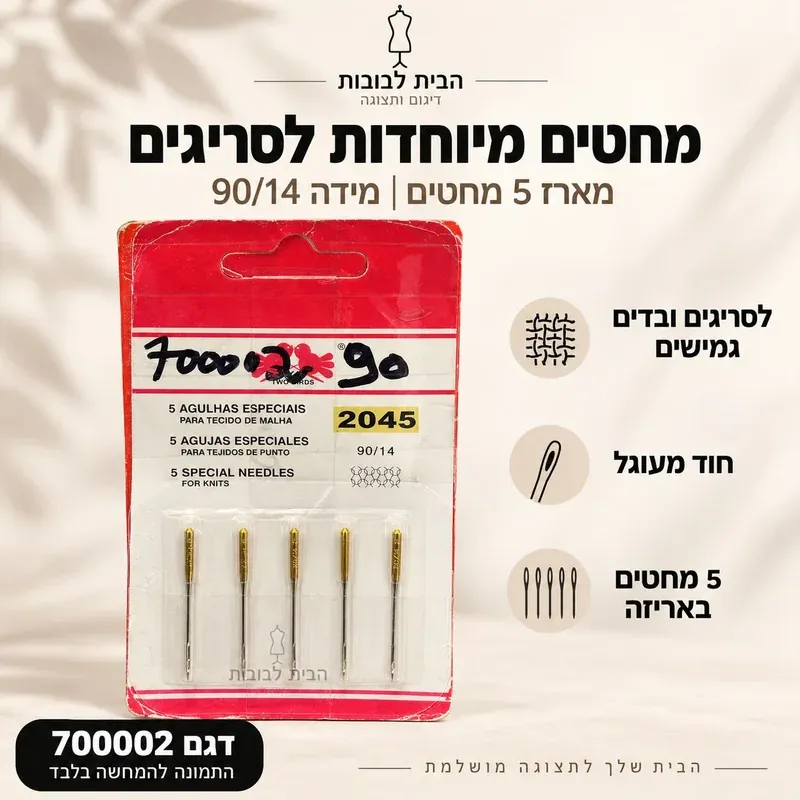
Jersey, single jersey, interlock and light sweatshirt fleece: ball point needle in size 80/12. This is the size for T-shirts and most light to medium-weight knits.
Heavy fleece, sweatshirts and heavy interlock: ball point needle in size 90/14, which is also suitable for joining several layers in a neckline or hem seam.
Lycra, swimwear and sportswear fabrics with high elastane content: here manufacturers recommend a Stretch needle, whose eye and scarf are shaped differently to reduce skipped stitches in very elastic fabric. If a ball point needle skips stitches in such fabric, that is the sign to switch to this type.
Beyond the needle, knit fabric needs a stitch that stretches with it: a narrow zigzag or the machine's stretch stitch. A regular straight stitch can break when the fabric stretches.
Matching the thread to the needle
General-purpose polyester sewing thread, such as Gütermann Sew-all, is intended according to the manufacturer for needles in the 70 to 90 range (10 to 14 in American sizing). This is the range where most home sewing falls, so one all-purpose thread covers most projects.
With a 60/8 needle, a finer thread is better, such as fine polyester or silk thread, so there is no friction in the eye.
With a 100/16 needle, when sewing with heavy thread for decorative topstitching, first check on a scrap that the thread flows without breaking.
For knit fabrics, polyester thread is better than cotton because it has some elasticity.
When switching to a thicker or finer thread, Schmetz recommends rechecking both the upper tension and the bobbin tension.
How to tell from the stitching that the needle is wrong
Most problems that look like a machine fault start with the needle. Schmetz's troubleshooting guide links each symptom to several possible causes, and a wrong or damaged needle appears in almost all of them.
The upper thread breaks
Common causes: a damaged or old needle, or a needle that is too small for the thread. Start by changing the needle, and if the thread is heavy, go up one size. If that doesn't help, rethread and check the upper tension.
Skipped stitches
A damaged needle, the wrong size or a point type unsuited to the fabric. In knit fabric, a universal needle is the first suspect. In very elastic fabric, even a ball point needle may skip.
Thread shreds and frays in the seam
Usually the needle is too small for the thread. The eye is narrow, and the thread wears with every pass.
The fabric puckers along the seam
A blunt point, tension that is too tight or a stitch length that is too long. In this case Schmetz recommends changing the needle, shortening the stitch length and checking the upper and bobbin tension.
Holes along the seam or pulled threads
In knit fabric, a sign of a point that is cutting loops. In delicate woven fabric, a sign of a needle that is too thick or a point damaged by hitting a pin.
A clicking sound with every stitch
Schmetz lists a clicking or popping noise among the signs of a worn needle. Change the needle and check again.
When to change needles, and which pack to keep at home
Schmetz recommends changing the needle after about eight hours of sewing or at the end of every project. With heavy fabrics, synthetic fabrics and sewing through layers, the needle wears faster, so it is worth changing it sooner.
If you sew different fabrics, it is handy to keep several sizes on hand. The ORGAN universal needle pack in mixed sizes includes 70/10, 80/12, 90/14 and 100/16, meaning a needle for each group of woven fabrics in the map above. If you also sew jersey, add a pack of 80/12 ball point needles. Sewing studios and schools, where needles are replaced quickly, usually keep a larger stock of the most common sizes, 80/12 and 90/14.
To keep needles from getting mixed up, store used needles separately from new ones, and return each needle to the package with its size. A needle taken out of its package without a marking is hard to identify by eye.
In summary
First determine whether the fabric is woven or knit, then choose a size by weight, and finally check that the thread suits the needle eye. When the stitching skips, breaks or puckers, change the needle first and only then adjust the machine. All the needles for home machines, ORGAN and Prym in sizes 60/8 to 100/16 and ball point needles for knit fabrics, are in the Needles category. For a question about a specific fabric or a volume price quote for a studio or school, you can contact us by phone at 03-9444226 or on WhatsApp at 055-2473993.
Frequently asked questions
What does the letter H in the 130/705H marking mean?
130/705 is the needle system for domestic sewing machines, with a shank that is flat on one side. According to Schmetz, the letter H indicates a needle with a scarf above the eye, which allows the machine's hook to catch the thread and form a stitch, and a slightly rounded point. The same needle is sometimes marked HAx1 or 15x1.
What is the difference between a universal needle and a ballpoint needle?
A universal needle has a slightly rounded point, suited mainly to woven fabrics such as cotton, linen and gabardine. A ballpoint needle has a more rounded tip that pushes the loops of knit fabric aside instead of piercing them. On knits such as jersey and interlock, it reduces holes and skipped stitches.
Can I sew jersey with a universal needle if I don't have another one?
On thick, stable knits a universal needle may work, but on thin or stretchy jersey it can cut the loops. The resulting holes are not always visible right away and sometimes widen after washing. For a garment that needs to last, it is better to use a ballpoint needle in size 80/12.
Why do small holes appear along the seam in knit fabric?
Holes along a seam in knit fabric are usually a sign that the point is cutting the fabric's loops instead of pushing them aside. This happens with a universal needle or a damaged needle. Switch to a new ballpoint needle in a size that suits the fabric weight: 80/12 for jersey and 90/14 for heavy sweatshirt fleece.
Which needle is right for linen?
For medium-weight linen, a universal needle in size 90/14 works well, and it also suits gabardine, light wool and corduroy. For very fine linen you can go down to 80/12. It is a good idea to test on a scrap of the same fabric before you start sewing.
Which thread suits an 80/12 needle?
General-purpose polyester sewing thread suits an 80/12 needle. Gütermann, for example, recommends its Sew-all thread for needles in the 70 to 90 range. For very fine thread it is better to go down to a finer needle, and for thick topstitching thread go up a size.
Why does my thread keep breaking even after I changed the needle?
If a new needle didn't solve the problem, the needle may be too small for the thread, so the thread frays in the eye. Other causes are incorrect threading, upper tension that is too tight, or old, knotted thread. Check the threading and tension first, then try a needle one size larger.
Why does fine fabric pucker at the seam when sewing?
Seam puckering on fine fabric usually comes from a dull point, thread tension that is too tight or a stitch length that is too long. Switch to a new, fine needle, 60/8 or 70/10, use fine thread and shorten the stitch length slightly. If the puckering remains, lower the upper tension slightly.
Is a thicker needle safer for every fabric?
No. A thick needle leaves larger holes, and on fine fabrics it can pull threads and leave marks that don't go away. A thick needle is needed only when the fabric is heavy or when sewing through several layers, so that the needle doesn't bend or break.
Should I buy a mixed-size pack or a single-size pack?
If you sew many different fabrics, a mixed pack pays off because it has a needle for every fabric weight. If you mostly sew one type of fabric, such as denim or jersey, you will use up one size faster and will prefer a pack of that size. Studios and schools usually keep both.